
Swiss-Type Lathe Tooling Guide
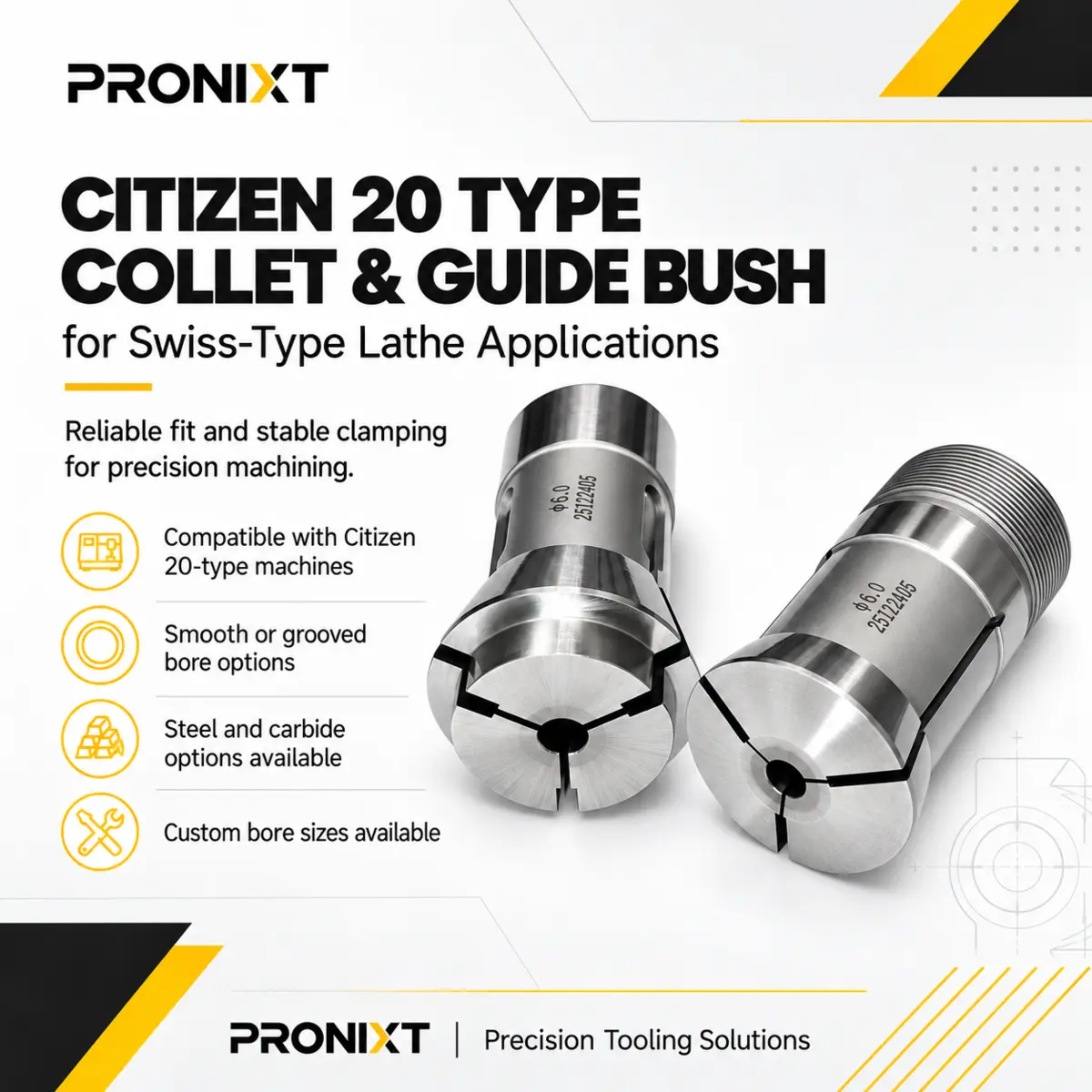
Citizen 20-Type Collets and Guide Bushes for Swiss-Type Lathes
Citizen 20-type collets and guide bushes support accurate bar gripping and guidance in Swiss-type lathe production. Correct selection requires more than the machine brand and nominal bar capacity.
Compatibility Basics
What Does “Citizen 20 Type” Mean?
“Citizen 20 type” is commonly used as a tooling-family or size reference for certain collets and guide bushes. It does not necessarily indicate the machine’s maximum bar capacity, and it should not be treated as a complete compatibility specification.
Different Citizen machine models, generations and tooling positions may use different collet or guide bush families. Even when two parts appear interchangeable, small differences in body diameter, length, taper, thread, shoulder position or connection details can prevent correct installation.
Compatibility should therefore be checked against the complete machine model, tooling position, existing reference number, dimensional drawing or physical sample.
Tooling Functions
Collet and Guide Bush: Different Roles
Both components work around the bar, but they perform different functions and require different selection criteria.
Main- or Sub-Spindle Collet
The collet grips the bar or finished component and transfers spindle rotation. The design depends on spindle position, workpiece geometry, clamping length and surface-protection requirements.
- Main-spindle or sub-spindle position
- Round, hexagon, square or special-profile bore
- Smooth, grooved or application-specific grip
Guide Bush
The guide bush supports the bar close to the cutting zone. Proper bore clearance helps limit radial movement while still allowing the stock to rotate and feed without binding.
- Steel or carbide-lined construction
- Bore matched to actual stock condition
- External geometry matched to the machine system
Bore Configuration
How to Select the Bore Design
The bore should be selected around the actual workpiece geometry, gripping demand and allowable surface marks.
Smooth Bore
A smooth bore is often selected when the workpiece surface must be protected or when the application does not require aggressive gripping. Suitability still depends on clamping load and machining conditions.
Grooved Bore
A grooved bore can provide additional grip for suitable bar-working applications. Groove style, pitch and depth should be selected around material, clamping area and marking tolerance.
Custom Profile
Round, hexagon, square, step, taper and other special bores can be produced from a confirmed drawing or sample. Dimensions, tolerances and orientation requirements should be clearly defined.
Material Selection
Steel or Carbide-Lined Tooling?
Steel is a practical option for many standard applications, prototypes and small-to-medium production quantities. A carbide-lined bore can offer higher wear resistance in suitable production environments, particularly where long running time and repeated bar contact increase bore wear.
The best choice depends on workpiece material, stock finish, expected quantity, required accuracy and replacement interval—not on the material name alone.
Technical Confirmation
Information Required Before Ordering
Providing complete information helps reduce identification errors and shortens the technical confirmation process.
| Item to Confirm | Recommended Information |
|---|---|
| Machine | Brand, complete model designation, machine generation if known, and nominal bar capacity. |
| Tooling position | Main spindle, sub-spindle, guide bush or another specific installation position. |
| Existing tool | Engraved number, clear photos, dimensional drawing or an available physical sample. |
| External geometry | Body diameters, overall length, taper, shoulder position, thread and locating features. |
| Bore requirement | Shape, finished size, tolerance, smooth or grooved grip, and any orientation requirement. |
| Application | Workpiece material, actual stock range, surface condition, required accuracy and order quantity. |
Selection Workflow
A Practical Four-Step Confirmation Process
Identify the Machine
Record the full machine model and the exact position in which the tool will be installed.
Confirm External Dimensions
Compare the body, length, taper, thread, shoulder and all other locating features.
Define the Bore
Specify actual stock dimensions, profile, tolerance, grip style and surface-marking limits.
Review the Application
Check material, production quantity, accuracy target and any known setup problem before approval.
Avoid Identification Errors
Common Selection Errors
- Ordering by machine brand only: the full model and tooling position are still required.
- Matching only the bore diameter: external dimensions and locating geometry determine whether the tool fits.
- Using nominal stock size only: guide bush clearance should consider measured stock range, roundness and surface condition.
- Assuming carbide solves every problem: alignment, stock quality, lubrication and machine condition remain critical.
- Copying a worn sample without review: wear or previous modification can distort the dimensions that should be reproduced.
Frequently Asked Questions
Citizen 20-Type Collet and Guide Bush FAQ
Does “Citizen 20 type” mean the machine has a 20 mm bar capacity?
No. “Citizen 20 type” is generally a tooling-family or size reference. It does not necessarily indicate the machine’s maximum bar capacity. Confirm the exact machine model, tooling position and principal dimensions before ordering.
Can PRONIXT produce a custom bore size?
Yes. Custom round, hexagon, square and special-profile bores can be evaluated from a drawing, measured stock information or representative sample.
Should I choose a smooth or grooved collet bore?
The choice depends on gripping demand, workpiece material, clamping length and allowable surface marks. Provide the application details so the bore style can be reviewed.
When is a carbide-lined guide bush useful?
It can be useful when wear resistance and longer production life are priorities. Correct stock condition, clearance, alignment and lubrication are still necessary.
What should I send if I do not know the tooling number?
Send the complete machine model, tooling position, clear photos and key dimensions. A drawing or physical sample provides additional confirmation.
Need a Citizen 20-Type Collet or Guide Bush?
Send PRONIXT your complete machine model, tooling position, existing reference or dimensions, bore requirement, workpiece material and quantity. Drawings, photos and samples are welcome.