
SOLID CARBIDE DRILLING
How Internal Coolant Holes Improve Solid Carbide Drilling
Internal coolant channels deliver cutting fluid through the drill body toward the cutting zone. When machine pressure, flow and filtration are suitable, this supports heat control, chip evacuation and stable performance—especially in deeper holes and demanding materials.
THROUGH-COOLANT DESIGN
What Internal Coolant Holes Actually Do
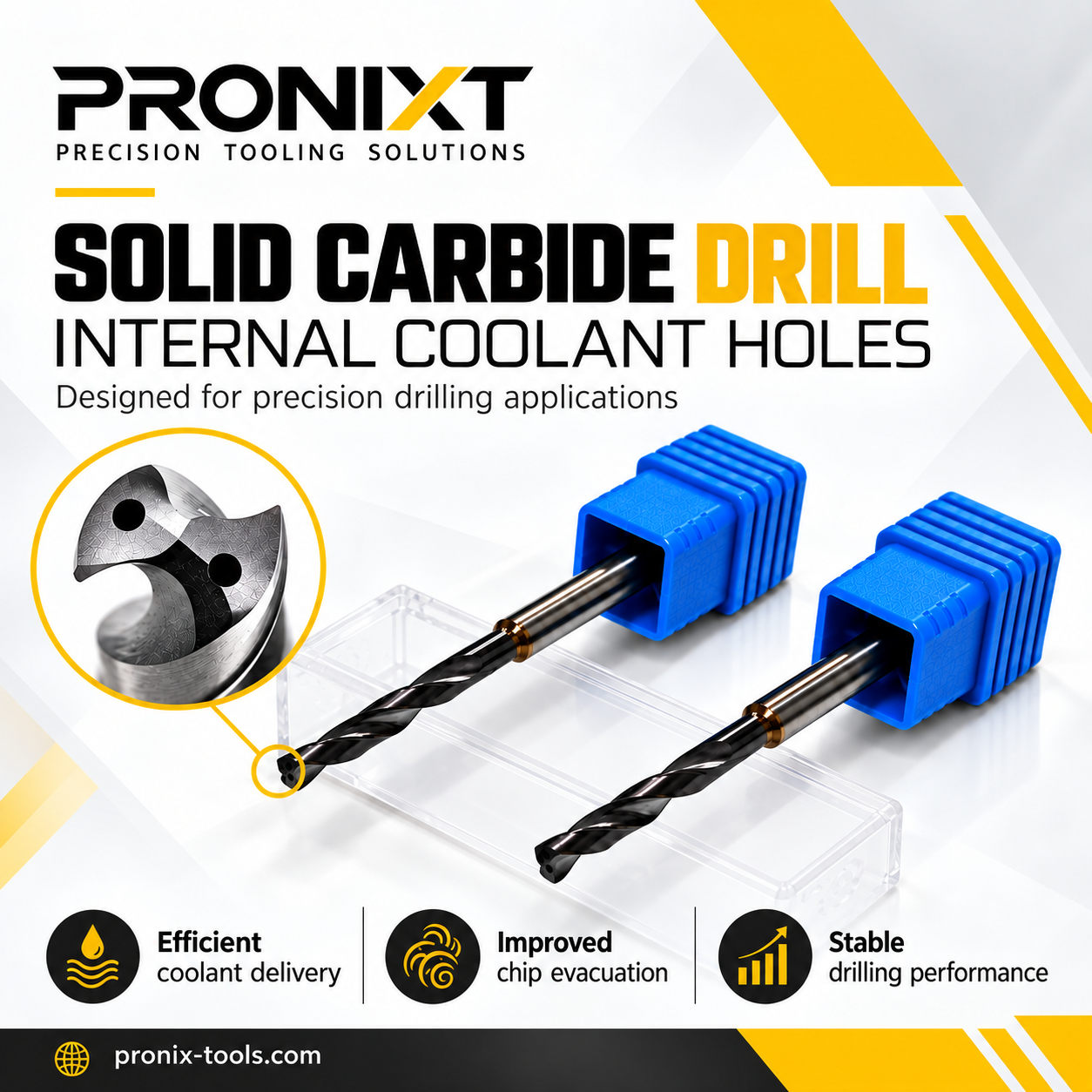
The two coolant channels visible at the drill end connect the machine’s coolant supply to the cutting zone. Their value is not simply that the drill contains holes; the complete system must move enough clean coolant through the tool under the actual cutting conditions.
Coolant Delivery
Coolant travels through the drill body and exits close to the cutting edges, helping it reach a zone that becomes harder to access as hole depth increases.
Chip Evacuation
Coolant flow helps move chips along the flutes and out of the hole, reducing the risk of chip packing when the application and cutting data are correctly matched.
Stable Drilling
More consistent cooling and chip removal can support a more stable process in stainless steel, alloy steel, tool steel, titanium and high-temperature materials.
COOLANT CONFIGURATION
When Should You Choose Internal Coolant?
External coolant remains a practical choice for short or medium-depth holes when the cutting zone is accessible and chips can leave the hole freely. Internal coolant becomes more useful as the hole becomes deeper, chip evacuation becomes less reliable or the material generates more heat.
- Choose internal coolant when drilling 5×D holes or when chip evacuation is a recurring limitation.
- Consider it for demanding workpiece materials and continuous production where process consistency matters.
- Confirm that the machine, spindle, holder and coolant system can supply the required pressure and flow.
- Use external coolant where machine capability or application depth does not justify a through-coolant tool.
PRONIXT DRILL SELECTION
Compare GB-DB, DIN-OB 3×D and DIN-OB 5×D
The correct series depends on diameter, required drilling depth, material and coolant capability. The comparison below summarizes the standard ranges shown on the PRONIXT product pages.
GB-DB Solid Carbide Drills
Available from Ø0.50 to 12.00 mm. Coated models serve steel and difficult materials, while uncoated options are available for aluminum, acrylic and copper.
Coolant: Standard external coolant
DIN-OB 3×D Drills
TiSiN-coated drills for stable production drilling in stainless steel, alloy steel, tool steel, titanium and high-temperature materials.
Range: Ø3.0–20.0 mm · 140° point · external or internal coolant
DIN-OB 5×D Drills
Designed for deeper drilling where flute length, coolant access and chip evacuation become more important to process stability.
Range: Ø3.0–20.0 mm · 140° point · external or internal coolant
3×D example: Ø6.8 mm / standard shank / internal coolant = DIN-OB3XD-068-C
5×D example: Ø6.8 mm / standard shank / internal coolant = DIN-OB5XD-068-C
Identification rule: the “-C” suffix indicates the internal-coolant configuration.
DEPTH-TO-DIAMETER RATIO
Why Hole Depth Changes the Coolant Decision
As drilling depth increases, external coolant has a longer and more difficult path to the cutting edges, while chips must travel farther before leaving the hole. This makes coolant delivery and chip control increasingly important.
Short to Medium Depth
Both external- and internal-coolant DIN-OB versions are available. Selection depends on material, production conditions and the machine’s coolant capability.
Deeper Standard Drilling
Internal coolant is especially relevant when deeper holes make chip evacuation and cutting-zone cooling more difficult.
Custom Deep-Hole Drills
For applications beyond the standard 5×D range, PRONIXT can customize 8×D, 10×D, 12×D and 16×D drills according to the material, hole size, machine and coolant conditions.
MACHINE AND SETUP CHECK
Setup Requirements for Internal-Coolant Drilling
A reliable internal-coolant application begins with the complete drilling system, not the tool alone. Review the machine and setup before selecting cutting conditions.
- Available coolant pressure and flow at the tool, not only at the pump
- Coolant filtration suitable for the tool’s internal channels
- Holder and spindle interfaces capable of transferring coolant without excessive leakage
- Low runout and sufficient machine rigidity for the selected diameter and depth
- Cutting speed, feed and drilling strategy matched to the material and setup
ORDERING CHECKLIST
Information to Send for Technical Confirmation
Providing the complete application allows the drill series, coolant configuration and custom requirements to be checked together.
| Information | What to Provide | Why It Matters |
|---|---|---|
| Workpiece material | Material grade and hardness | Supports carbide grade, coating and cutting-data selection |
| Hole size | Finished diameter and tolerance | Confirms standard size availability or custom manufacture |
| Hole depth | Exact depth, blind or through hole, and target ratio such as 3×D, 5×D, 8×D, 10×D, 12×D or 16×D | Determines the standard or custom depth ratio and chip-evacuation requirement |
| Coolant system | External or through-spindle supply, pressure, flow and coolant type | Confirms whether the internal channels can operate effectively |
| Machine and holder | Machine model, spindle interface, holder type and runout condition | Supports a stable setup and correct tool interface |
| Production target | Batch size, cycle-time target and current tool performance | Clarifies whether the priority is stability, output or problem solving |
Review the complete solid carbide drill range, compare the DIN-OB 3×D drills and DIN-OB 5×D drills, or send your application for technical confirmation.
FREQUENTLY ASKED QUESTIONS
Internal Coolant Drill FAQ
Is internal coolant necessary for every solid carbide drill?
No. External coolant can be effective for shorter holes and accessible cutting zones. Internal coolant becomes more valuable when depth, material or chip control makes coolant delivery difficult.
What does the “-C” suffix mean in a PRONIXT drill model?
For the DIN-OB 3×D and 5×D drill ranges, the “-C” suffix identifies the internal-coolant version with through-coolant channels.
Which drill depths can PRONIXT customize beyond 5×D?
PRONIXT can customize 8×D, 10×D, 12×D and 16×D solid carbide drills. Final geometry and coolant design are confirmed according to the diameter, material, hole type, machine rigidity and coolant conditions.
Need Help Selecting an Internal Coolant Drill?
Send the material grade and hardness, hole diameter and depth ratio, tolerance, machine and holder details, coolant pressure and flow, quantity and production target for standard 3×D and 5×D or custom 8×D, 10×D, 12×D and 16×D drill confirmation.