
Main-Spindle vs. Sub-Spindle Collets: Bore Design and Application Differences
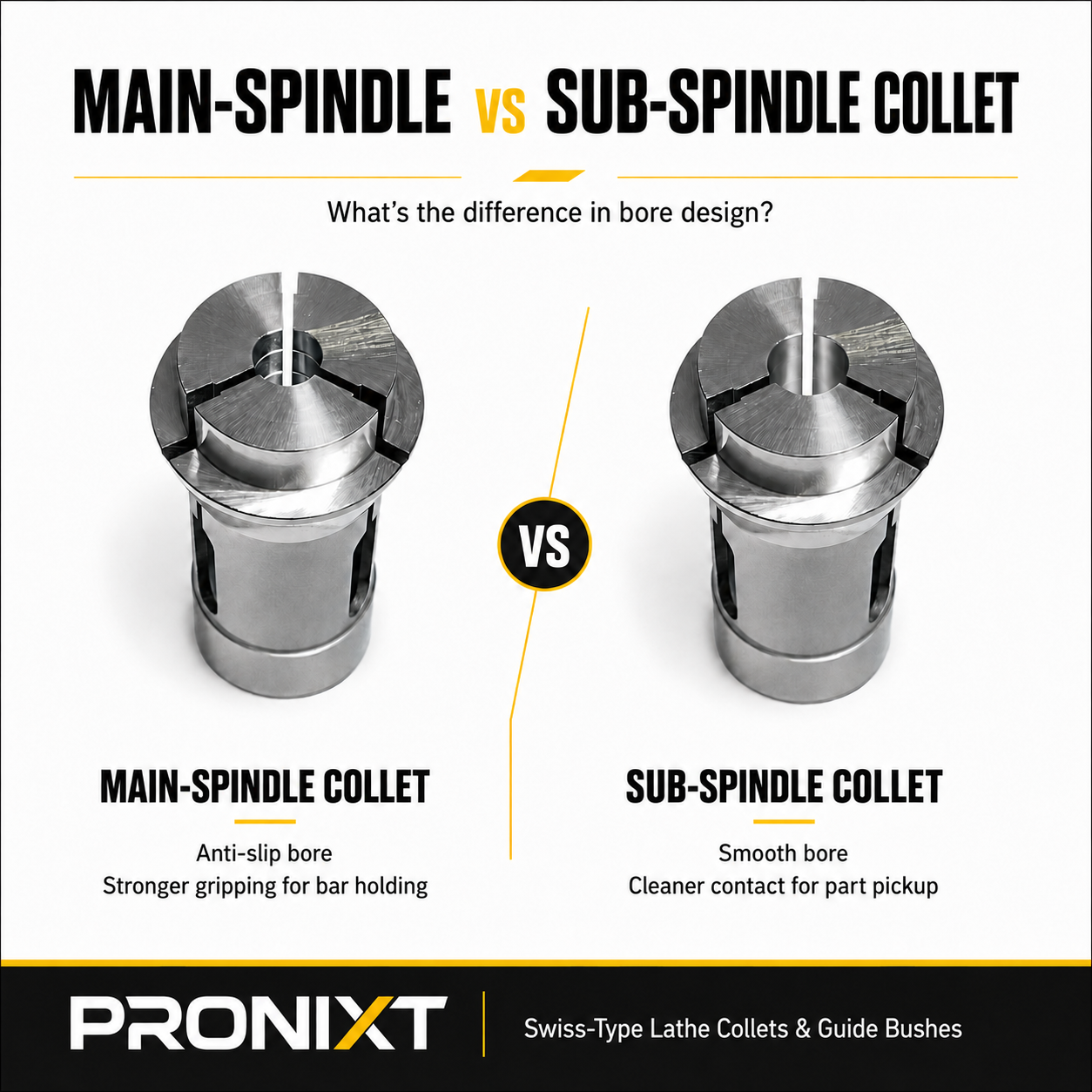
Main-spindle and sub-spindle collets may look similar externally, but their gripping responsibilities are often different. The main spindle commonly holds incoming bar stock during machining, while the sub-spindle commonly picks up a partially or fully machined component for back-working operations.
Why Does the Collet Bore Matter?
The collet bore is the direct contact surface between the workholding tool and the workpiece. Its design influences gripping resistance, torque transmission, axial stability, surface marking and repeatability.
Raw bar stock and finished components do not always require the same gripping strategy. Raw material may need stronger resistance against rotation or axial movement during cutting. A finished component may require gentler and more uniform contact to protect the machined surface during part pickup.
The correct bore style should be selected according to the machining stage, workpiece condition, cutting load and surface requirements—not only according to whether the collet is installed in the main spindle or sub-spindle.
Main-Spindle and Sub-Spindle Collet Comparison
Main-Spindle Collet
Common Bore: Anti-Slip DesignThe main spindle commonly grips incoming bar material while cutting forces and spindle torque are transferred through the workpiece. Anti-slip grooves can increase resistance against unwanted rotation or axial movement.
- Commonly used for holding raw bar stock
- Improves resistance to rotational slipping
- Supports higher cutting and axial loads
- Useful for oily or relatively smooth bar surfaces
- May leave light gripping marks on the workpiece
Sub-Spindle Collet
Common Bore: Smooth DesignThe sub-spindle commonly receives a machined component for back-working operations. A smooth bore provides more even contact and reduces the risk of marking an already finished diameter.
- Commonly used for finished-part pickup
- Reduces marking on machined surfaces
- Provides clean and uniform contact
- Suitable for precision back-working operations
- Requires correct bore size and gripping length
Anti-Slip Bore vs. Smooth Bore
| Comparison Item | Main-Spindle Collet | Sub-Spindle Collet |
|---|---|---|
| Typical workpiece stage | Incoming raw or semi-finished bar stock | Partially or fully machined component |
| Common bore style | Anti-slip or grooved bore | Smooth bore |
| Main priority | Holding force and resistance to slipping | Surface protection and stable pickup |
| Torque requirement | Generally higher during primary machining | Depends on the back-working operation |
| Surface-marking risk | Higher with aggressive anti-slip grooves | Lower when bore size and contact are correct |
| Typical application | Bar holding and primary machining | Part pickup and secondary machining |
What Should Be Confirmed Before Ordering?
Machine Model
Confirm the Swiss-type lathe brand, machine model and whether the collet is for the main or sub-spindle.
Workpiece Stage
Identify whether the collet holds raw bar stock, a semi-finished part or a finished pickup diameter.
Bore Diameter
Provide the actual workpiece diameter, tolerance and required bore shape.
Workpiece Material
Steel, stainless steel, aluminum, brass and coated materials may require different gripping considerations.
Machining Load
Consider spindle torque, axial cutting force, feed direction and the required gripping length.
Surface Requirements
Confirm whether light gripping marks are acceptable or whether the finished surface must remain unmarked.
This Is a Common Practice, Not an Absolute Rule
A main-spindle collet does not always require an anti-slip bore, and a sub-spindle collet does not always require a smooth bore. Delicate bar surfaces may require a smooth main-spindle bore, while demanding back-working operations may require additional gripping resistance in the sub-spindle. Final bore selection should be based on the actual workpiece and machining conditions.
Main and Sub-Spindle Collet FAQ
Does every main-spindle collet need anti-slip grooves?
No. Anti-slip grooves are common when stronger resistance to torque or axial movement is needed, but a smooth bore may be preferable for delicate surfaces or lower-load applications.
Can a smooth-bore collet be used in the main spindle?
Yes. A correctly sized smooth bore can provide stable gripping when the machining load, contact length and workpiece surface are suitable.
Should every sub-spindle collet have a smooth bore?
Not necessarily. Smooth bores are commonly selected to protect finished pickup diameters, but higher-load secondary operations may require additional gripping resistance.
What information is needed for a collet quotation?
Provide the machine model, main or sub-spindle position, workpiece diameter and shape, workpiece material, required quantity and any surface-marking restrictions.
Need Help Selecting the Correct Collet Bore?
Send us your machine model, workpiece dimensions, workpiece material and machining requirements for evaluation.