
What Is a Feeding Collet? Design, Function and Bar Feeder Compatibility
A feeding collet connects the bar feeder pusher to the rear end of the bar stock. It must grip consistently, release predictably and match both the material diameter and the bar feeder connection.
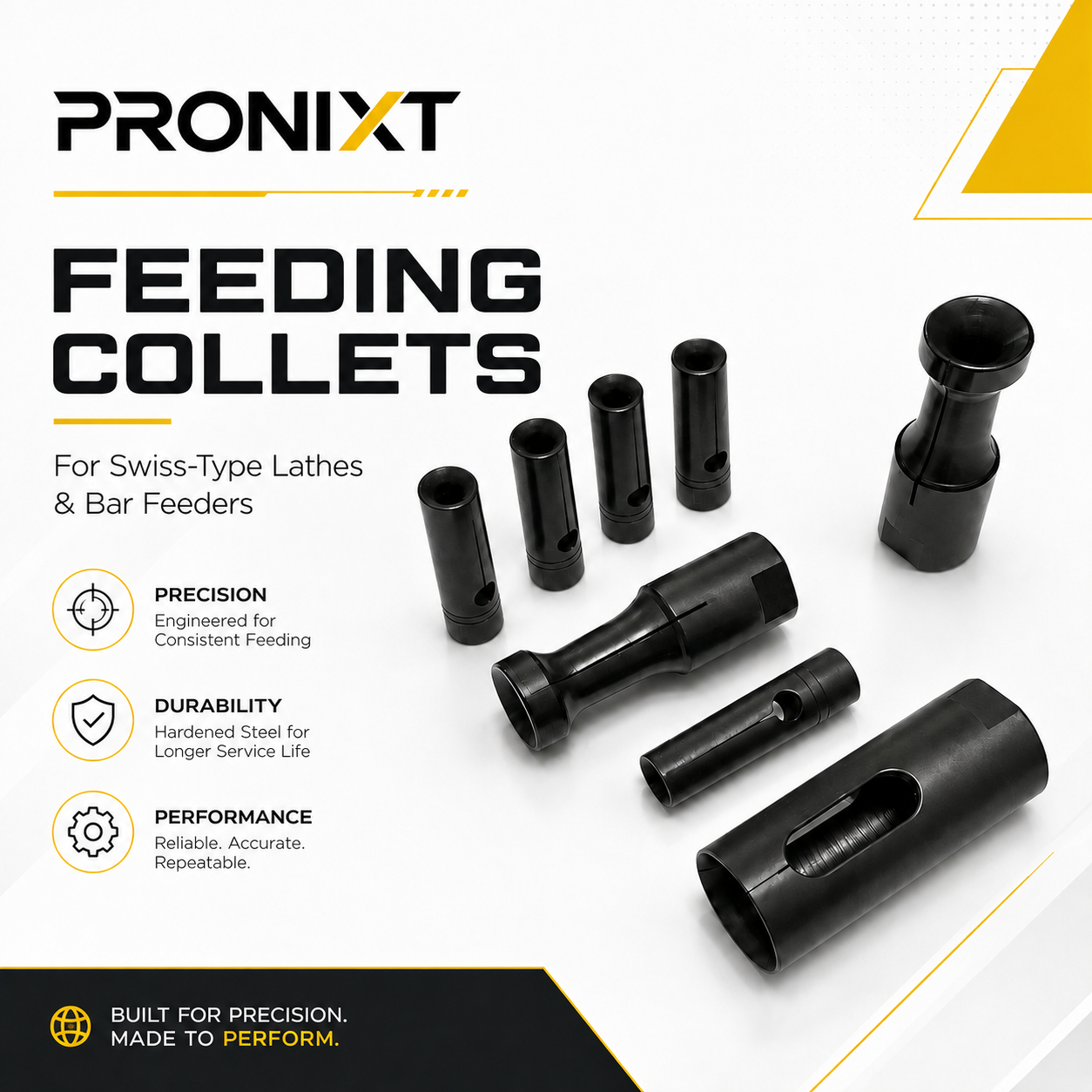
What Does a Feeding Collet Do?
During automatic production, the bar feeder must advance stock into the spindle accurately and repeatedly. The feeding collet grips the rear end of the bar so the pusher can move it forward after each machining cycle.
Unlike a spindle collet, a feeding collet is not the primary workholding device during cutting. Its main job is controlled bar transport. The bore must grip strongly enough to prevent the bar from slipping out during feeding, but it must not damage the stock or create excessive insertion resistance.
A feeding collet belongs to the bar feeder pusher assembly, while the spindle collet belongs to the CNC lathe. The two components perform different functions and are not selected by the same dimensions.
How a Feeding Collet Moves Bar Stock
Grip the Bar
The rear end of the bar enters the feeding collet. The bore and slot geometry create the required elastic gripping force around the material.
Advance the Material
The bar feeder pusher moves forward and transfers the bar through the guide channel toward the lathe spindle.
Repeat the Cycle
After each part is cut off, the feeder advances the required length again to support continuous automatic production.
How Is the Feeding Collet Bore Size Determined?
Feeding collets use a round bore and are ordered according to the specified bar size. For square and hexagonal stock, the specified across-flats dimension is converted into a circumscribed-circle diameter to determine the round-bore size.
Round Bar
Use the Specified Bar DiameterThe feeding-collet bore is normally made 0.3 to 0.5 mm smaller than the specified round-bar diameter.
Example: A 16.00 mm round bar normally requires a bore of approximately 15.50–15.70 mm. See the detailed gripping principle below.
Square Bar
Across Flats × 1.35Convert the specified across-flats dimension into the circumscribed-circle diameter used for the round bore.
Example: A 10.00 mm square bar has a 14.14 mm circumscribed-circle diameter for the round-bore calculation.
Hexagonal Bar
Across Flats × 1.155Convert the specified across-flats dimension into the circumscribed-circle diameter used for the round bore.
Example: A 10.00 mm hexagonal bar has an 11.55 mm circumscribed-circle diameter for the round-bore calculation.
When the bar enters the feeding collet, the slightly smaller round bore causes the slotted front section to expand elastically. The spring force created by this elastic recovery grips the material so the pusher can move it reliably. A bore that is too large may not hold the bar securely, while an excessively small bore can create too much insertion force. Final sizing should therefore be based on the specified bar dimensions and the required feeding condition.
Why the Bar Feeder Model Matters
The same bar diameter does not mean that two feeding collets are interchangeable. LNS, IEMCA, BARLOAD, FMB, ALPS, IKURA and other bar feeder systems may use different pusher connections, body sizes, lengths and retention methods.
| Item to Confirm | Why It Matters | Recommended Information |
|---|---|---|
| Bar feeder brand and model | Determines the basic feeding-collet interface | Nameplate photo or complete model number |
| Pusher connection | Controls how the collet is mounted and retained | Existing collet dimensions, drawing or clear photos |
| Bar diameter and tolerance | Determines gripping force and insertion resistance | Specified bar diameter and dimensional tolerance |
| Bar shape | Square and hexagonal stock use a round bore calculated from the circumscribed circle | Round-bar diameter or specified across-flats size |
| Custom requirements | Non-standard body or connection dimensions require drawing review | Complete dimensional drawing |
What Should Be Confirmed Before Ordering?
Feeder Model
Provide the manufacturer and complete model of the bar feeder, not only the CNC lathe model.
Existing Collet
A drawing, sample or clear dimensional photos help confirm the body and connection design.
Specified Bar Size
Provide the round-bar diameter or the specified across-flats size for square and hexagonal bars.
Bar Shape
Confirm whether the material is round, square or hexagonal so the correct round-bore calculation can be applied.
Custom Drawing
For a non-standard feeding collet, provide a complete drawing showing the body and connection dimensions.
Required Quantity
Quantity helps determine the suitable production method, spare requirement and delivery plan.
Custom Manufacturing from Drawings
Custom feeding collets can be manufactured according to customer drawings. Please provide the bar feeder model, outside diameter, overall length, connection dimensions, required round-bore size and any other critical dimensions for evaluation before production.
Feeding Collet FAQ
Is a feeding collet the same as a spindle collet?
No. A feeding collet moves bar stock through the bar feeder, while a spindle collet holds the workpiece during machining.
How is the correct feeding-collet bore selected?
For round bars, the bore is normally 0.3 to 0.5 mm smaller than the specified bar diameter. Square and hexagonal bars use a round bore calculated from their specified across-flats dimension.
Why is the feeding-collet bore smaller than the bar?
The smaller bore causes the slotted collet section to expand elastically when the bar is inserted. The resulting spring force provides the grip needed to advance the material.
Can one feeding collet fit different bar feeder brands?
Only when the mounting interface and all relevant dimensions are identical. Brand or bore diameter alone is not enough to confirm interchangeability.
How are square and hexagonal bars held?
The feeding collet still uses a round bore. For square bar, multiply the across-flats size by 1.35. For hexagonal bar, multiply it by 1.155. These calculations convert the specified bar size into its circumscribed-circle diameter.
Need a Feeding Collet for Your Bar Feeder?
Send us the bar feeder brand and model, existing collet dimensions, bar size, material and surface requirements for evaluation.