
Collets & Guide Bushes
How to Identify Swiss-Type Lathe Collets and Guide Bushes
A machine brand alone is not enough to confirm a replacement tool. Reliable identification combines the exact machine model, tool type, external dimensions, bore requirements and any available reference number.
Identification Basics
Why Correct Identification Matters
Swiss-type lathe collet identification can be difficult because one dimensional family may be used across several machine models, while similar-looking collets or guide bushes may differ in length, taper, thread, shoulder position or connection details. Selecting a part only by appearance or bore diameter can therefore lead to an incorrect fit.
In a sliding-headstock Swiss-type lathe, the guide bush supports the bar close to the cutting zone. This helps control deflection during the machining of long or slender parts. The spindle collet must grip and locate the bar correctly, while the guide bush must allow controlled movement without excessive play or binding. Both components must match the machine and the actual bar stock.
Start Here
The Three Pieces of Information to Confirm First
Machine Brand and Exact Model
Record the complete model shown on the machine nameplate. Series names, bar capacity and model suffixes can affect tooling compatibility.
Tool Type and Position
Confirm whether the item is a main-spindle collet, sub-spindle collet, guide bush, pickoff collet or another clamping component.
Actual Dimensions
Measure the external geometry and connection features. Do not identify a tool only from its bore size or the nominal bar diameter.
Measurement Guide
Which Collet Dimensions Should Be Measured?
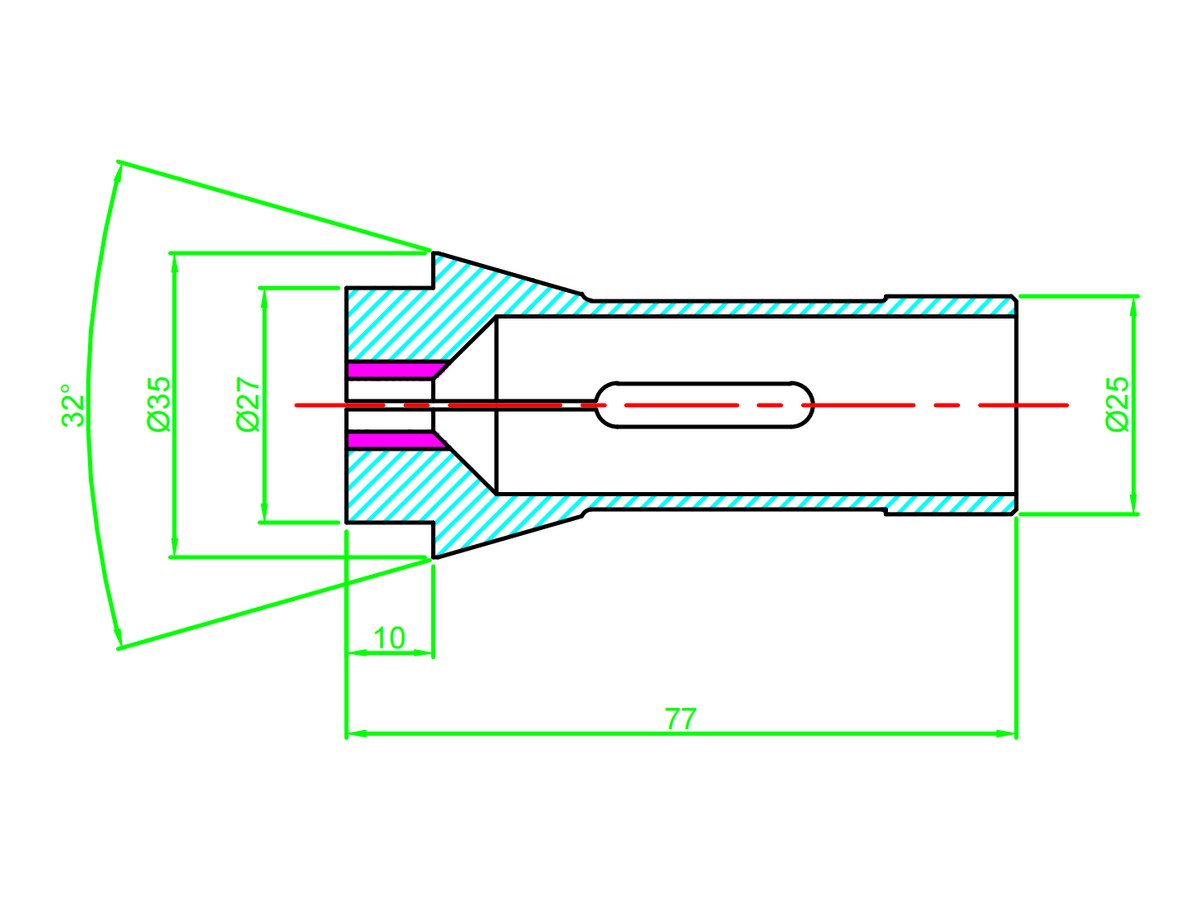
Remove the collet safely and clean its locating surfaces before measurement. A vernier caliper is useful for preliminary checking, but precision measuring equipment may be required when two models are very similar. Record the values in millimeters and photograph the same features shown on the drawing.
| Collet feature | What to record | Why it matters |
|---|---|---|
| Body diameter | Main outside diameter and any stepped diameters | Determines whether the collet fits the spindle or collet sleeve. |
| Overall length | End-to-end length and shoulder location | A similar diameter with a different length may not clamp or release correctly. |
| Front geometry | Nose diameter, front length and locating surfaces | Controls seating position and clearance around the spindle nose. |
| Taper angle | Included or half angle as defined by the drawing | An incorrect taper can produce poor contact, runout or premature wear. |
| Bore | Round, hexagon, square or special profile; smooth or gripping design | The bore must match the workpiece geometry and required clamping method. |
Guide Bush Details
Which Guide Bush Dimensions Should Be Measured?
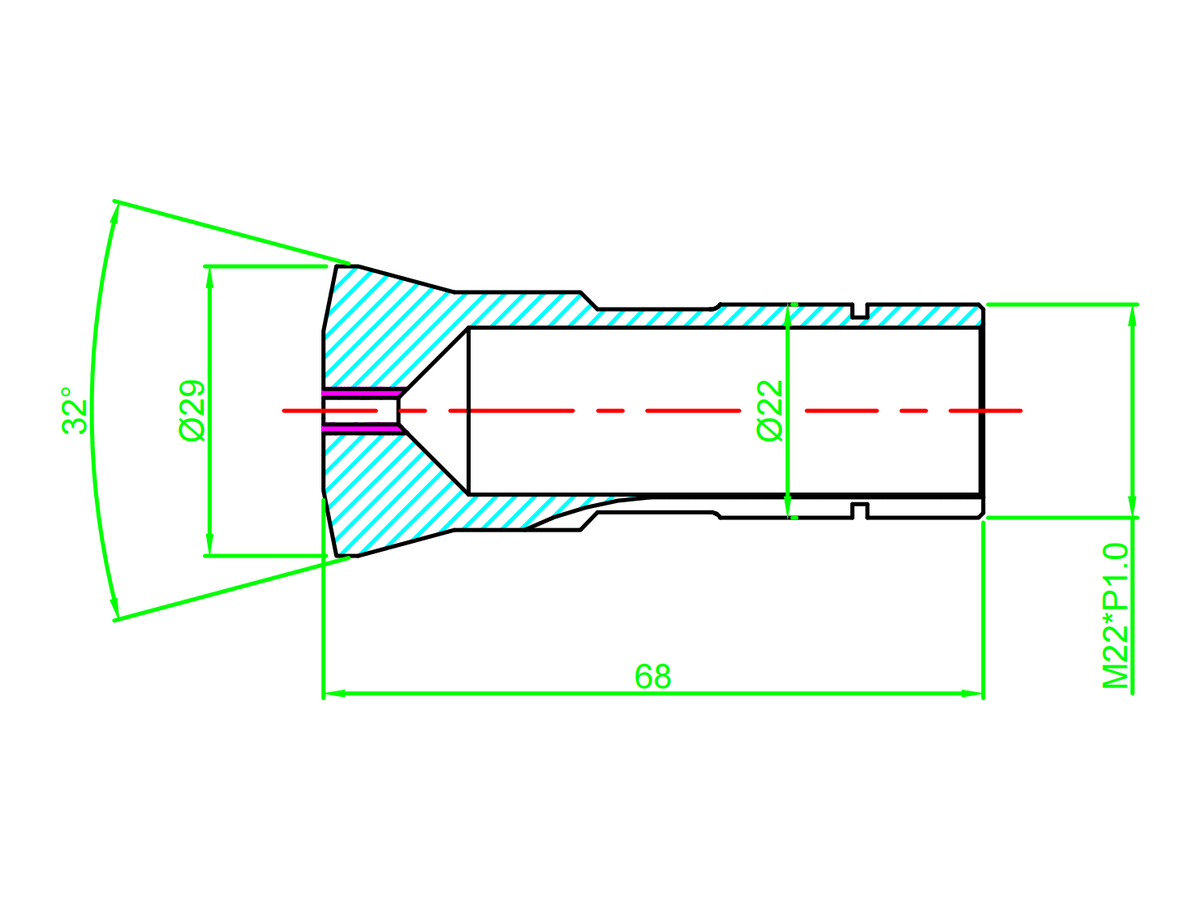
A guide bush requires the same careful dimensional comparison, with extra attention to the connection thread and locating geometry. Record the actual bar diameter as well as its tolerance and surface condition. Guide-bush clearance must be set according to the machine builder’s procedure and the real bar stock; there is no single clearance value suitable for every machine, material and application.
| Guide bush feature | What to record | Why it matters |
|---|---|---|
| Body diameters | External locating diameters and steps | Confirms compatibility with the guide bush holder and machine assembly. |
| Overall length | Total length, shoulder position and front projection | Affects axial seating and the relationship between the support point and cutting tools. |
| Thread | Major diameter, pitch and thread direction | Similar guide bushes can use different connection specifications. |
| Locating angle | Angle and mating surface dimensions | Correct contact is necessary for concentric seating and stable support. |
| Bore requirement | Actual stock size, tolerance, shape and desired material option | Too much clearance reduces support; insufficient clearance can cause heat, marking or binding. |
General Numbers
Use Common Model Numbers as a Cross-Reference
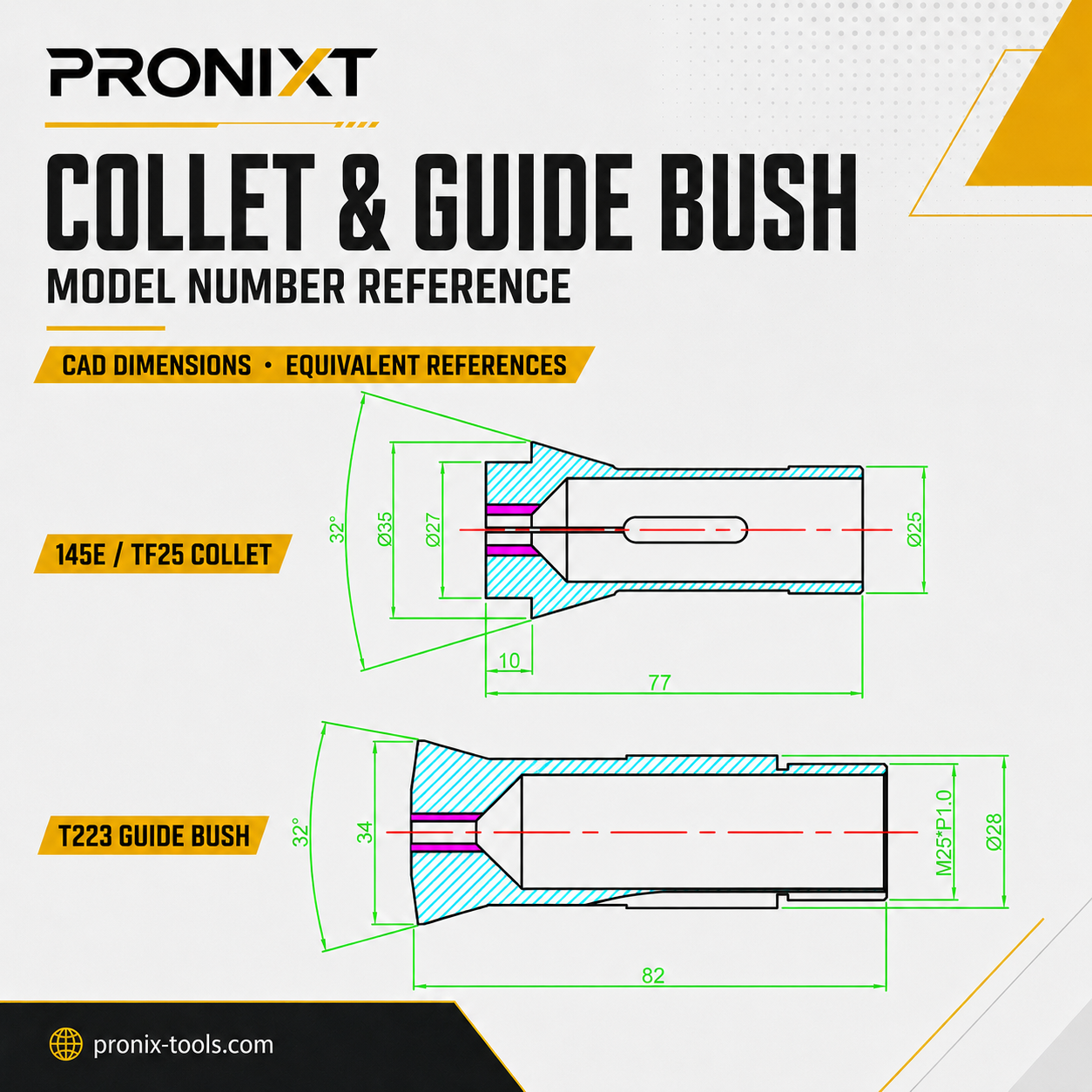
The same dimensional family may appear under several references used by machine builders, tooling suppliers or regional catalogs. For example, a 145E collet may also be listed as TF25 or F25 76-64. These references make searching easier, but the complete dimensions still need to be confirmed.
View additional dimensional families in the PRONIXT collet and guide bush model number reference.
Photo Checklist
What Photos Should Be Sent for Identification?
Clear photographs often resolve details that are not visible in a simple dimensional list. Place the cleaned tool on a plain background and include a ruler or measured drawing when possible.
For a Collet
- Complete side view
- Front face and bore shape
- Rear end and connection details
- Any engraved model number or marking
- Visible slots, shoulders and taper surfaces
For a Guide Bush
- Complete side view
- Front face and carbide or steel bore
- Thread and rear locating features
- Any engraved model number or marking
- Worn, chipped or scored areas
Troubleshooting
Common Signs of an Incorrect or Worn Guide Bush
A dimensional problem is not always caused by the guide bush alone. Bar quality, spindle condition, tool alignment, cutting load, temperature and setup all affect the result. The following symptoms are useful starting points for inspection.
| Symptom | Possible areas to inspect |
|---|---|
| Bar stock binds or feeds inconsistently | Bore clearance, actual bar diameter, bar straightness, chips, contamination and guide bush adjustment. |
| Excessive heat or surface marking | Insufficient clearance, damaged bore surface, trapped chips, unsuitable stock finish or incorrect alignment. |
| Chatter, taper or unstable dimensions | Excessive clearance, worn bore, poor bar straightness, unsupported cutting length, tool condition and machine alignment. |
| Guide bush does not seat completely | Incorrect thread, body diameter, shoulder position, overall length, taper or debris on locating surfaces. |
| Premature wear or carbide damage | Incorrect setup, impact during installation, interrupted material surface, chips, insufficient lubrication or severe stock variation. |
Material Selection
Steel or Carbide-Lined?
Steel Collets and Guide Bushes
Steel construction is a practical option for many standard applications, prototypes and smaller production quantities. Heat treatment, bore finish and dimensional accuracy remain important.
Carbide-Lined Options
Carbide-lined tooling can provide improved wear resistance in suitable production applications. The choice should consider workpiece material, stock finish, cycle conditions, required accuracy and expected quantity.
Before Requesting a Quote
Information That Helps Confirm the Correct Tool
- Machine information: brand, complete model and whether the tool is used on the main spindle, sub spindle or guide bush assembly.
- Existing reference: any engraved number, supplier number, catalog reference or machine manual number.
- External dimensions: body diameters, overall length, shoulder position, taper and thread specification.
- Bore requirement: round, hexagon, square or special profile, including the actual stock size and tolerance.
- Application: workpiece material, required quantity and whether steel or carbide-lined construction is preferred.
- Visual reference: clear photos, dimensional drawing or an existing sample when a standard number cannot be confirmed.
PRONIXT provides compatibility pages for TSUGAMI, STAR, CITIZEN, TORNOS and additional Swiss-type lathe brands.
Brand names and machine models are shown for compatibility reference only. PRONIXT is an independent tooling supplier and is not affiliated with the listed machine manufacturers.
Frequently Asked Questions
Collet and Guide Bush Identification FAQ
Can a collet be identified only from the machine brand?
No. One brand may use several collet families across different machine models and capacities. The exact model and tool dimensions should be confirmed.
Is the bore diameter enough to identify a collet?
No. Bore diameter describes the workpiece size, but it does not confirm the collet’s external body, length, taper or connection geometry.
Can two different reference numbers describe the same collet family?
Yes. General numbers such as 145E, TF25 and F25 76-64 may be used as cross-references. Dimensions and machine compatibility must still be checked.
Why must the actual bar diameter be measured for a guide bush?
Nominal stock size does not show its real diameter, tolerance, straightness or surface variation. These conditions affect guide bush adjustment, support and free movement.
Can PRONIXT identify a tool from a drawing or sample?
Yes. A complete machine model, clear photographs and measured dimensions are usually the fastest starting point. A drawing or physical sample can be used when the model number is unavailable.
Need Help Identifying a Collet or Guide Bush?
Send us the machine model, available reference number, required bore, measured dimensions and clear product photos. We will review the information for a compatible standard or customized solution.
Leave a Reply