
Swiss-Type Lathe Tooling Reference
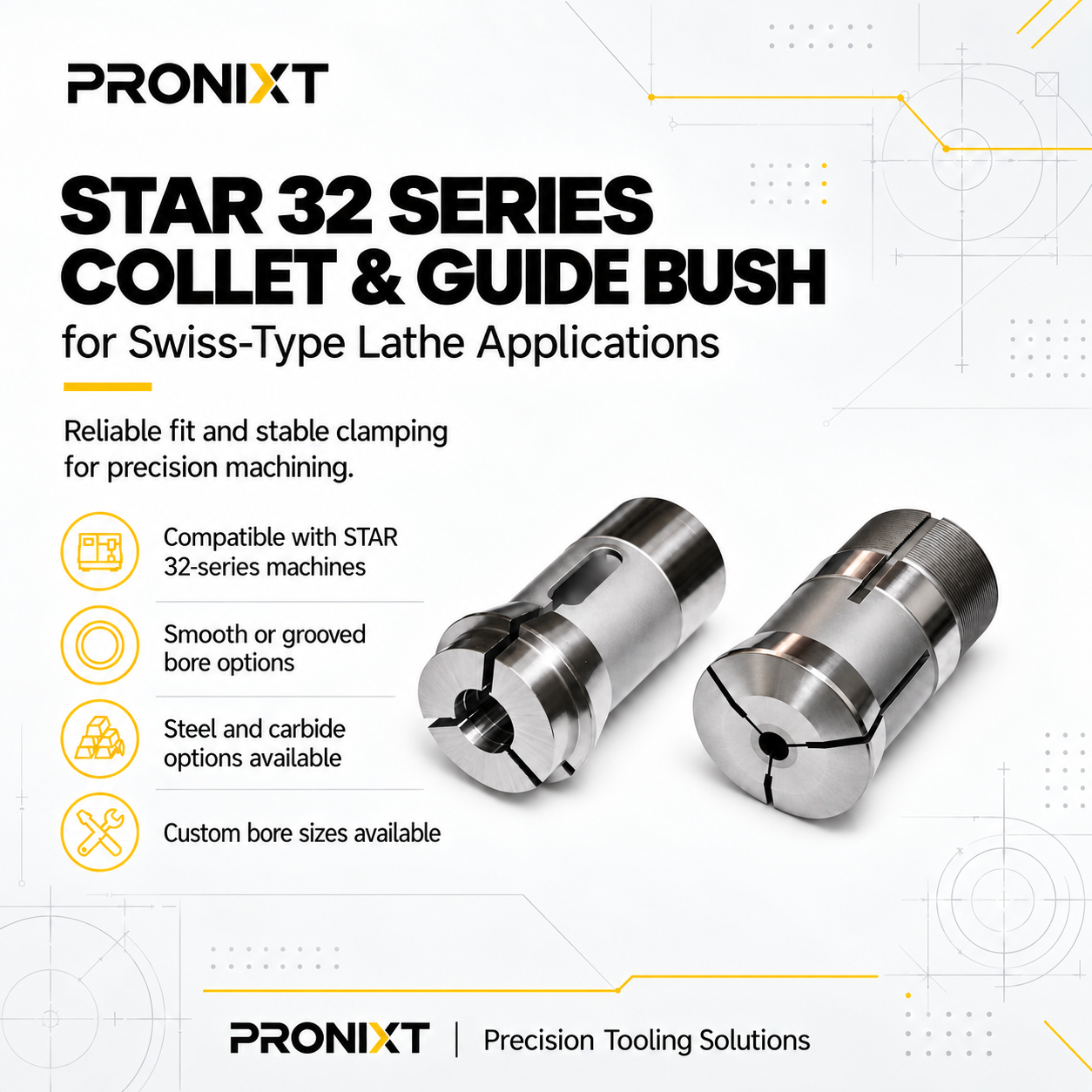
STAR 32 Series Collets and Guide Bushes
This guide explains how to identify a STAR 32 series collet and guide bush, compare common reference numbers, review bore capacities and prepare the information required for a reliable tooling quotation.
Application Overview
Tooling for STAR 32-Series Swiss-Type Lathes
Collets and guide bushes perform different but closely related functions. The collet grips and rotates the bar or component, while the guide bush supports the stock close to the cutting zone to help control movement and deflection.
- Standard and customized bore sizes
- Round, hexagon, square and special profiles
- Smooth, grooved and application-specific gripping
- Steel and carbide-lined options
Identification First
What Does “STAR 32 Series” Identify?
“STAR 32 series” is a useful compatibility description for tooling associated with selected 32-class STAR Swiss-type lathe models. It should not be treated as a complete part number or as proof that every tool marked for a 32 mm machine is interchangeable.
Models such as SR32, VNC32, KNC32, JNC32 and SV32J are commonly grouped together in this reference family. However, machine generation, spindle position, guide bush system and the external geometry of the existing tool still need to be confirmed.
Before selecting the bore, compare the body diameter, overall length, taper, shoulder, connection details and thread where applicable. The existing tooling number, drawing or physical sample can provide additional confirmation.
Technical Reference
STAR 32 Series Collet and Guide Bush Reference Data
The following dimensions and reference numbers are practical starting points for identification. Final production should follow the confirmed machine, tooling position, drawing and bore requirement.
STAR 32 Series Collet
Common reference family
- General references
- 1536E / TF37 / F37 76-740
- Main dimensions
- Ød 37.0 / ØD 47.0 / L 92.0 mm
- Front dimensions
- ØA 40.0 / ØB 10.0 mm
- Reference angle
- 16°
STAR 32 Series Guide Bush
Common reference family
- General references
- TD32S / T229 / T42-82-C16
- Main dimensions
- Ød 42.0 / ØD 49.0 / L 82.0 mm
- Connection thread
- M40 × P1.0
- Reference angle
- 16°
Reference note: Maximum bore capacity is not the same as a recommended production bore. Confirm the workpiece profile, actual measured stock, wall thickness, clamping demand and tool construction before selecting the final size.
Selection Workflow
Four Checks Before Selecting STAR 32 Tooling
A correct replacement starts with compatibility and then moves to the workpiece-specific bore design.
Machine and Position
Confirm the full STAR model, machine generation if known, and whether the tool is installed in the main spindle, sub-spindle or guide bush assembly.
External Geometry
Compare the body diameters, total length, taper, shoulder, thread and connection details with the existing component or approved drawing.
Bore and Grip
Define the finished bore size, profile, tolerance, smooth or grooved surface, clamping length and allowable workpiece marking.
Production Conditions
Review the workpiece material, actual bar variation, required accuracy, production quantity and any current gripping or guide bush problem.
Bore Configuration
Round, Profile and Special Bore Options
The bore must match the real workpiece geometry and the way the component needs to be gripped or supported.
Round Bore
Used for standard round bar and cylindrical workpieces. The final fit should consider actual stock diameter, roundness, surface finish and required guide bush movement.
Hexagon or Square Bore
Profile bores should be specified by the actual across-flats size, corner condition, orientation and tolerance—not by converting from a nominal round diameter.
Custom Bore
Step, taper and other special profiles can be evaluated from a dimensioned drawing, representative sample or confirmed workpiece data.
Material Choice
Steel or Carbide-Lined Construction?
Material selection should follow expected wear, quantity, stock condition and operating environment.
Steel Tooling
Steel is a practical choice for many standard applications, prototypes and small-to-medium production runs. Heat treatment, bore finish and dimensional control remain important.
Carbide-Lined Tooling
A carbide-lined bore can provide improved wear resistance for suitable long-running applications. It does not replace correct alignment, stock quality, lubrication or guide bush adjustment.
Practical Troubleshooting
Common Problems and What to Verify
Symptoms at the machine can help guide inspection, but the collet or guide bush should not be assumed to be the only cause.
| Observed Problem | Items to Check |
|---|---|
| Workpiece slipping | Bore size, groove style, clamping length, closing pressure, surface contamination and workpiece hardness. |
| Part surface marking | Bore finish, groove design, chips, excessive closing pressure, stock condition and whether a smooth bore is more suitable. |
| Bar binding in guide bush | Actual maximum stock size, roundness, straightness, heat, lubrication, trapped chips and guide bush adjustment. |
| Chatter or unstable size | Guide bush clearance, unsupported length, stock consistency, alignment, tool condition and cutting parameters. |
| Replacement will not install | Machine model, tooling position, body diameter, length, taper, shoulder, thread and model-reference equivalence. |
Quotation Checklist
What to Send Before Ordering
Complete information reduces identification errors and allows the bore, material and grip design to be evaluated together.
- Complete STAR machine model
- Main, sub-spindle or guide bush position
- Existing reference or engraved number
- Clear overall and detail photos
- Drawing or measured dimensions
- Bore shape, size and tolerance
- Workpiece material and actual stock range
- Required quantity and application notes
Frequently Asked Questions
STAR 32 Series Collet and Guide Bush FAQ
Which machine models are commonly associated with this STAR 32 series tooling family?
Common references include STAR SR32, VNC32, KNC32, JNC32 and SV32J. Compatibility still needs to be confirmed from the exact machine, tooling position, external dimensions and connection details.
What are the common reference numbers for a STAR SR32 collet?
A commonly referenced collet family is 1536E / TF37 / F37 76-740, corresponding to PRONIXT order number C-370470 in this reference. Do not rely on the number alone; compare all principal dimensions and the required application.
What are the common reference numbers for a STAR SR32 guide bush?
Common guide bush references include TD32S / T229 / T42-82-C16, corresponding to PRONIXT order number R-420490 in this reference. Confirm the M40 × P1.0 thread, overall geometry, bore and exact machine setup before ordering.
Can PRONIXT produce round, hexagon and square bores?
Yes. Round, hexagon, square and other customized bore profiles can be evaluated from a drawing, measured workpiece data or representative sample. Bore tolerance, orientation and gripping details should also be specified.
Should I order the guide bush bore from the nominal bar size?
Not without checking the actual production stock. Measure representative bars for maximum and minimum size, roundness and straightness, then follow the machine builder’s setup procedure and verify smooth movement under working conditions.
Can a worn collet or guide bush be copied from a sample?
A physical sample is useful, but wear, damage or previous modification may affect measured dimensions. Where possible, compare the sample with the machine model, reference number, drawing and functional requirements before reproduction.
Need a STAR 32 Series Collet or Guide Bush?
Send PRONIXT your complete machine model, tooling position, existing reference, required bore, workpiece material and quantity. Drawings, photos and samples are welcome for technical confirmation.